Why Unpredictable System Behavior Is the Silent Killer of Automation
Automation pipelines have revolutionized the way we deploy software and hardware systems at scale. Continuous integration, continuous deployment (CI/CD), and automated testing promise to streamline processes, reduce human error, and accelerate delivery.
However, one of the biggest threats to automation pipelines is non-deterministic behavior. While automation relies on predictable, repeatable processes, systems that exhibit non-deterministic or unpredictable behavior can cause automation failures, delays, and downtime. These issues are often subtle, difficult to detect, and can be exponentially more problematic at scale.
In this article, we will explore the impact of non-deterministic behavior on automation pipelines and discuss strategies for mitigating these risks.
What is Non-Deterministic Behavior?
Non-deterministic behavior refers to systems or processes that do not always produce the same outcome, even when given identical inputs and operating under identical conditions. In the context of automation pipelines, non-deterministic behavior can manifest in various ways:
Random failures: A build or deployment might succeed or fail without any apparent reason.
Inconsistent results: A test or integration step may produce different results each time it runs, even with identical code and infrastructure.
Environmental variations: Small changes in network conditions, hardware configuration, or even timing can cause different outcomes.
In automated systems, predictability is key. If a system doesn’t consistently behave the same way each time, automation becomes unreliable, which can disrupt workflows, cause delays, and lead to inconsistent deployments.
How Non-Deterministic Behavior Breaks Automation Pipelines
1. Unreliable Builds and Deployments
Automation pipelines rely on a series of steps that must be executed reliably to ensure successful deployment. If one step fails or behaves unpredictably, it can cause the entire pipeline to break. Examples include:
Random build failures: Inconsistent results in compiling or building the application, leading to failed CI builds without clear errors.
Intermittent deployment failures: If the environment or dependencies aren’t consistent across runs, deployments may fail intermittently, making troubleshooting incredibly difficult.
When builds and deployments aren’t predictable, teams are forced to spend excessive time and resources trying to reproduce errors, which disrupts the entire development cycle.
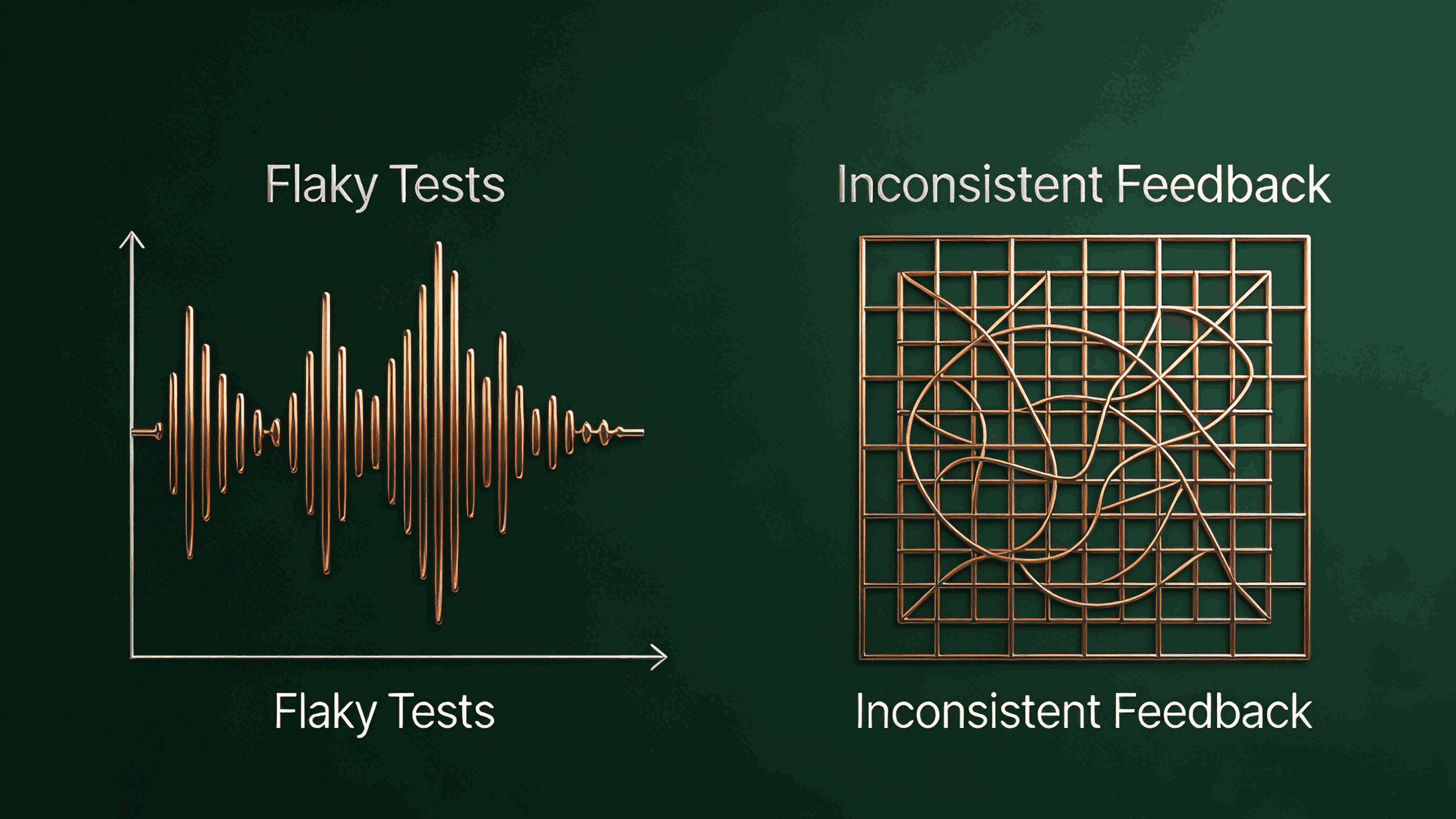
2. Flaky Tests and Inconsistent Feedback
Automated testing is a core part of continuous integration and deployment, but non-deterministic behavior can cause tests to pass or fail inconsistently. This can result in:
False positives: Tests that report failures when the system is working correctly, due to underlying environmental factors like race conditions, timing issues, or resource contention.
False negatives: Tests that pass when they shouldn’t, hiding critical issues that can only be exposed under specific conditions or at scale.
Flaky tests in the pipeline mean developers can no longer trust the feedback they receive from their CI/CD system. This results in delayed releases, increased rework, and potentially missed defects in production.
3. Dependency Issues and Configuration Drift
Non-deterministic behavior can also stem from subtle variations in system configuration or dependencies:
Configuration drift: Over time, slight changes in configuration settings (e.g., operating system patches, library updates, or hardware changes) can cause inconsistent behavior, even if everything looks identical in theory.
Dependency issues: Automated pipelines rely on dependencies that may not always be consistent, such as software versions, network latency, or cloud services. These variations can result in failures that are difficult to trace back to a root cause.
Inconsistent configurations and dependency mismatches make automation pipelines highly unreliable, leading to errors that are difficult to predict and time-consuming to fix.

4. Scaling Issues and Environmental Variability
As systems scale, non-deterministic behavior becomes even more problematic. Here’s why:
Scale amplifies environmental variability: A pipeline that runs smoothly on a single machine may encounter issues when scaled to multiple nodes, where network latency, hardware variations, or environmental conditions like temperature or power fluctuations start to affect performance.
Parallel processing inconsistencies: In large-scale deployments, parallel processes may lead to race conditions, where the outcome of a process depends on timing, making it difficult to predict or reproduce failures.
At scale, the impact of non-deterministic behavior grows exponentially, as small issues in a single instance can compound, causing widespread failure across the infrastructure.
Strategies to Mitigate Non-Deterministic Behavior in Automation Pipelines
1. Improve Environment Consistency
The first step to mitigating non-deterministic behavior is ensuring that your test and deployment environments are consistent and reproducible:
Use containers (e.g., Docker) or virtual machines to create isolated environments that can be replicated across different stages of the pipeline.
Infrastructure as Code (IaC) tools like Terraform and Ansible allow you to define infrastructure in code, ensuring that every environment is created with identical configurations.
Use CI/CD pipelines to automatically test and verify that the configuration matches the desired state before deployment.
2. Use Retry Mechanisms for Flaky Operations
For steps that may exhibit non-deterministic behavior (like network requests or interactions with third-party services), retry mechanisms can help:
Use exponential backoff strategies to retry operations that fail due to network or temporary resource issues.
Ensure that idempotent operations are used in automation tasks, meaning they can be repeated without changing the result, even if they are executed multiple times.
By handling intermittent failures gracefully, you can increase pipeline stability and avoid downtime caused by temporary issues.
3. Implement Advanced Monitoring and Logging
Effective monitoring is essential to catching non-deterministic behavior early:
Set up real-time monitoring to track key performance indicators (KPIs) such as build success rates, test pass rates, and deployment completion times.
Use logging to track the specific environment and configuration at the time of each failure, which will help you identify patterns and troubleshoot underlying causes.
Implement distributed tracing to identify issues in complex, multi-service deployments.
Monitoring tools can give you visibility into how systems are behaving in the pipeline, helping to isolate and correct the sources of non-deterministic behavior before they cause major disruptions.

4. Test in Production-like Environments
Testing in environments that mirror production as closely as possible is crucial:
Set up staging environments that replicate production infrastructure and traffic patterns to catch issues that may only occur under real-world conditions.
Use load testing to simulate user behavior at scale and identify potential scalability issues, race conditions, or configuration problems before they affect users.
Perform chaos engineering exercises to test how the system behaves under unexpected failure scenarios, helping you uncover hidden non-deterministic behavior.
By testing in production-like environments, you can ensure that the automation pipeline handles real-world complexities and is resilient to unpredictable behavior.
Conclusion: Tackling Non-Deterministic Behavior for Reliable Automation
Non-deterministic behavior poses a significant challenge to automation pipelines. Whether it’s flaky tests, unreliable deployments, or scaling issues, unpredictability can break automation workflows, leading to delays, errors, and ultimately downtime.
By ensuring environment consistency, implementing retry mechanisms, and using advanced monitoring and testing, you can reduce the risk of non-deterministic behavior and ensure that your automation pipelines are reliable, resilient, and capable of handling the complexities of modern system deployments.