For OEMs and system integrators, integration time is not a soft metric.
It directly affects:
Time-to-market
Engineering utilization
Project margins
Customer confidence
Yet many integration delays are still treated as inevitable.
In practice, teams that adopt validated builds consistently reduce integration time by 30% or more — without increasing engineering headcount.
1. Where Integration Time Is Really Spent
Most integration schedules assume time is spent on:
Assembly
Imaging
Basic functional testing
In reality, the majority of time is lost to:
Debugging unpredictable behavior
Re-testing after component swaps
Resolving firmware and driver mismatches
Aligning multiple vendors during escalation
These delays do not appear on project plans — but they dominate execution.

2. What a “Validated Build” Actually Means
A validated build is not simply:
A compatible BOM
A reference design
A system that boots
A true validated build includes:
Fixed component combinations
Locked BIOS, BMC, and firmware versions
OS-specific driver baselines
Verified stress and interaction testing
Documented upgrade and rollback paths
This turns integration from experimentation into execution.

3. How Validated Builds Eliminate Rework
Rework is the largest hidden cost in integration.
Validated builds reduce rework by:
Removing component-level uncertainty
Preventing late-stage compatibility surprises
Ensuring consistent behavior across units
When every system behaves the same way, integration becomes repeatable — not reactive.
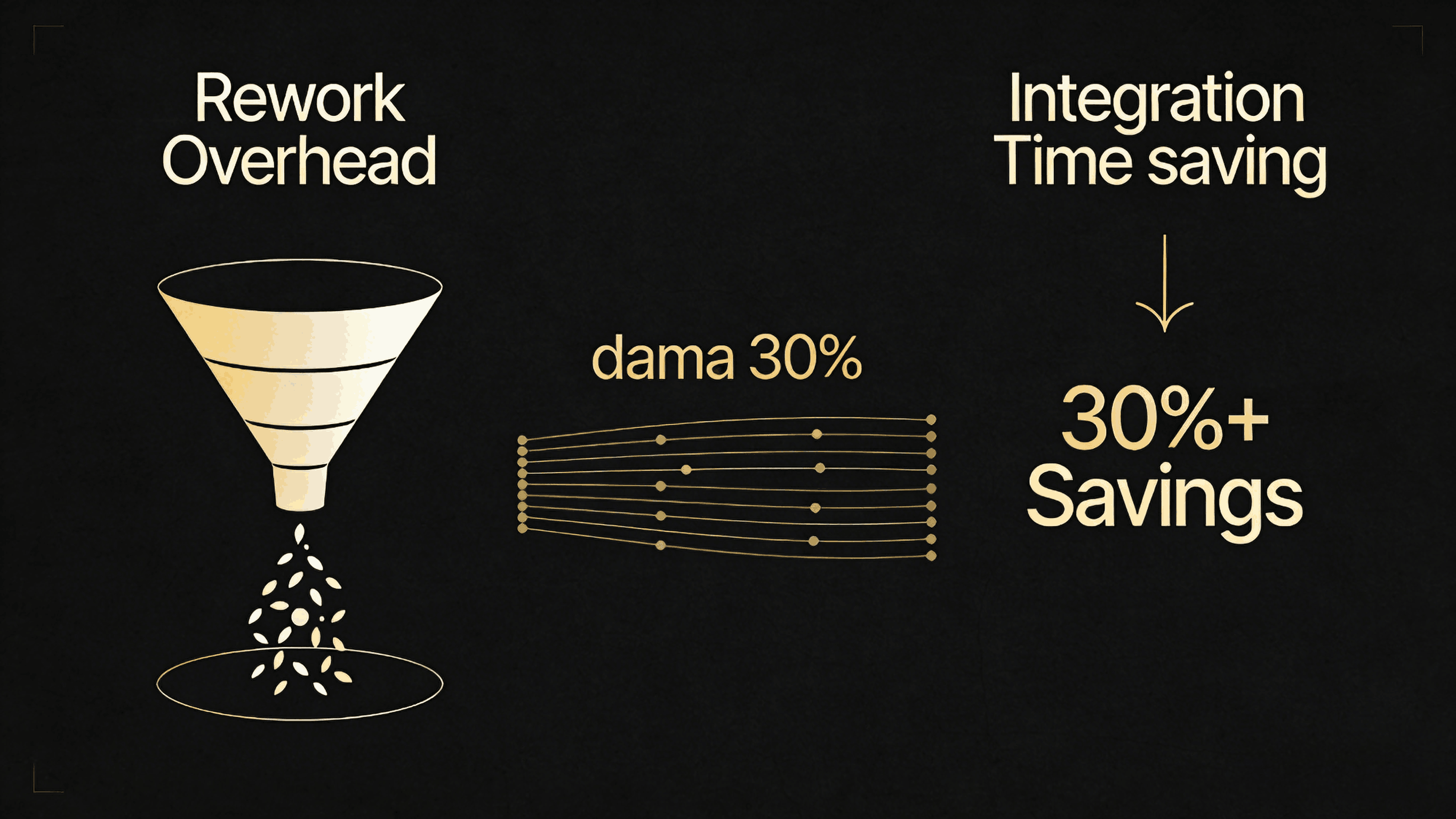
4. Where the 30%+ Time Savings Comes From
Across OEM and SI deployments, the time reduction typically comes from:
Fewer Debug Loops
No repeated trial-and-error component changes.
Shorter Validation Cycles
Testing confirms known behavior instead of discovering new problems.
Faster Issue Resolution
Known baselines make root cause analysis immediate.
Reduced Cross-Vendor Escalation
Validated stacks limit finger-pointing between suppliers.
5. Predictability Is the Real Accelerator
Integration speed improves not because teams work faster —
but because they stop waiting.
Waiting for:
Vendor feedback
Replacement parts
Firmware fixes
Re-testing approvals
Validated builds remove these pauses by front-loading engineering work.
6. Why OEMs and SIs Benefit Disproportionately
For OEMs and system integrators:
Integration delays directly erode margin
Engineering overruns cannot be easily passed to customers
Delivery predictability is a competitive differentiator
Validated builds convert integration from a risk phase into a controlled process.
7. The Organizational Impact
Teams using validated builds report:
Engineers spend time integrating systems — not chasing inconsistencies.
Conclusion
Validated builds do not reduce integration time by cutting corners.
They reduce it by eliminating uncertainty.
For OEMs and system integrators, a 30%+ reduction in integration time is not the result of working harder —
it is the result of working on systems that behave predictably from day one.
In complex infrastructure, predictability is the fastest path to scale.