Welcome: Shenzhen Angxun Technology Co., Ltd.
tom@angxunmb.com 86 18933248858

Industry news

How to Choose the Right Core Board for Your Digital Signage Project: A Deep ARM vs. x86 Comparison

Choosing the right core board is one of the most important early decisions in any digital signage project. Whether you're building menu boards for QSR chains, interactive kiosks for transportation hubs, or large-format advertising displays, the performance and stability of your system will ultimately depend on the platform you select.


Among all available architectures, ARM and x86 dominate the digital signage industry. Each offers unique advantages—and trade-offs—that directly impact cost, performance, power efficiency, future scalability, and software compatibility.

This article provides a neutral, engineering-level comparison to help integrators and solution providers make informed decisions. It concludes with scenario-based recommendations and matching core-board options from Angxun Technology, aligned with real-world deployment needs.


1. Performance Requirements: High Responsiveness vs. Efficient Rendering

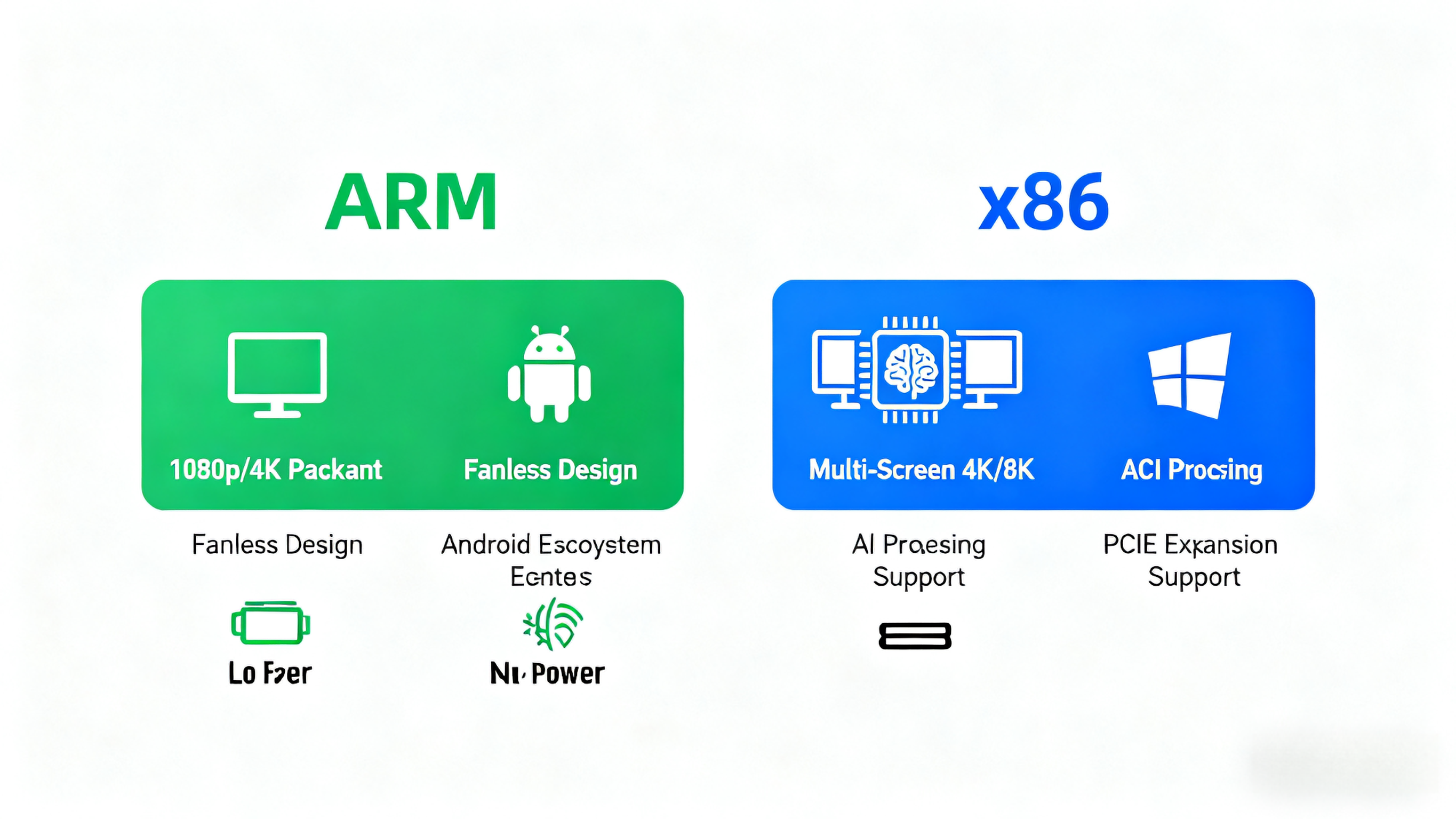
ARM: Optimized for Lightweight to Medium Workloads

Modern ARM SoCs integrate CPU, GPU, VPU, and AI acceleration in a single, efficient package.

Best suited for:

  • Smooth 1080p or light 4K video playback

  • Digital menu boards

  • Simple interactive kiosks

  • Low-power, always-on displays

Strengths:

  • Excellent video decoding capabilities per watt

  • Smaller thermal footprint

  • Lower cost structure

Limitations:

  • Lower sustained multi-threaded performance

  • Limited compatibility with Windows-based CMS systems

digital-signage-arm-x86-core-board-comparison (1).png

x86: Optimized for Heavy Visual and Multi-Task Workloads

x86 platforms provide robust performance for more demanding applications.

Best suited for:

  • Multi-screen 4K/8K playback

  • AI-enabled content strategies

  • Interactive wayfinding systems

  • Edge analytics (people counting, heatmaps, scene analysis)

Strengths:

  • High single-thread and multi-thread performance

  • Broad OS compatibility (Windows, Linux, Android x86)

  • Mature driver ecosystem

Limitations:

  • Higher power consumption

  • Requires more advanced thermal design


2. Power Consumption and Thermal Design: Passive vs. Active Cooling

ARM: Extreme Efficiency

  • Ideal for fanless systems

  • Enables ultra-slim enclosures (10–15 mm)

  • Lower heat dissipation simplifies long-term reliability engineering

Applications:

  • Retail shelves

  • Smart bus stops

  • Low-maintenance indoor advertising

digital-signage-arm-x86-core-board-comparison (4).png

x86: Performance Requires Thermal Budget

While modern x86 CPUs (Intel 12–14th Gen, AMD Ryzen Embedded) have improved efficiency, they still require:

  • Larger heatsinks

  • In many cases, low-noise fans

  • Stable power delivery systems

Applications:

  • Outdoor digital signage

  • High-brightness displays

  • Edge servers for content processing


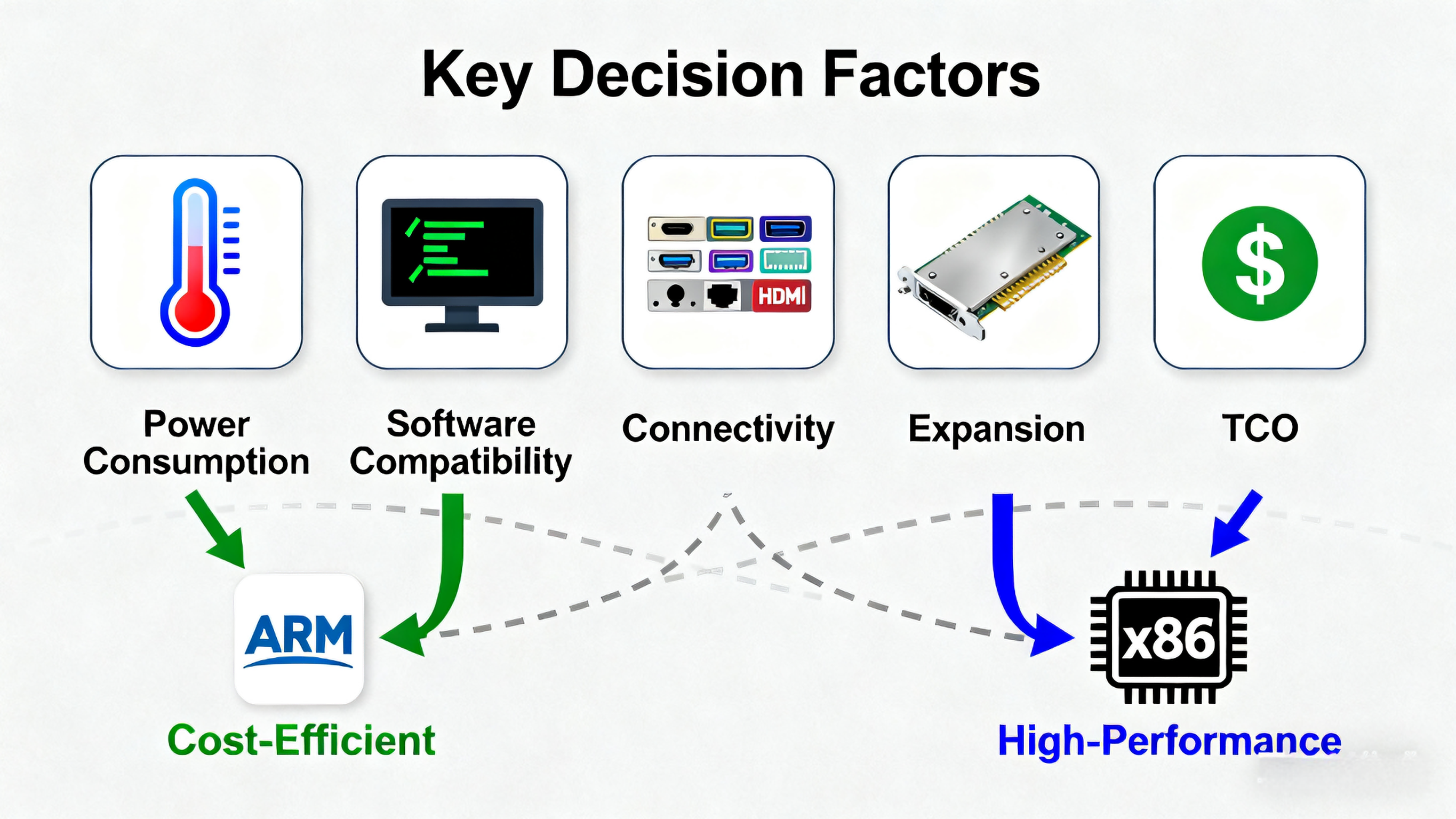
3. Software Ecosystem and CMS Compatibility

ARM Advantages

  • Extremely strong Android ecosystem

  • More economical licensing

  • Rich support for custom app development

  • Fast cold boot for applications requiring power cycling

x86 Advantages

  • Full Windows ecosystem support (CMS, enterprise software, security suites)

  • Legacy industrial protocol compatibility

  • Easy migration from older x86 platforms

  • Broader driver and peripheral support (PCIe, USB, capture cards, sensors)

 digital-signage-arm-x86-core-board-comparison (3).png

4. Connectivity and Expansion Capabilities

ARM Platforms Typically Offer:

  • HDMI or LVDS/eDP for single display output

  • Optional dual display on higher-end SoCs

  • Limited PCIe expansion

  • Integrated WiFi/BT/LTE options

x86 Platforms Offer:

  • 2–3 HDMI/DP outputs for multi-screen environments

Full PCIe slots for:

    • capture cards

    • AI accelerators

    • high-performance NICs


  • Broad industrial GPIO options

For digital signage projects requiring multiple displays, external sensors, or advanced peripherals, x86 delivers stronger expansion capabilities.


5. Total Cost of Ownership (TCO)

Factor

ARM

x86

Hardware cost

Low

Medium–High

Software licensing

Low

Medium–High

Power cost

Very Low

Medium

Thermal / enclosure cost

PREVIOUS:High-Reliability, Low-TCO Mini PC Solutions for Digital Signage Integrators NEXT:Beyond Specifications: How We Engineer “Never-Down” Reliability Into Every Motherboard We Design

CATEGORIES

CONTACT US

Contact: Tom

Phone: 86 18933248858

E-mail: tom@angxunmb.com

Whatsapp:86 18933248858

Add: Floor 301 401 501, Building 3, Huaguan Industrial Park,No.63, Zhangqi Road, Guixiang Community, Guanlan Street,Longhua District,Shenzhen,Guangdong,China