
tom@angxunmb.com
86 18933248858
In today’s fast-moving IT landscape, server hardware and software are evolving faster than ever. New CPUs, SSDs, NICs, firmware, hypervisors, and operating systems are released constantly—each promising better performance, security, and energy efficiency.
But for many organizations, staying current is difficult not because of the cost of new hardware, but because of the time and risk involved in integrating everything together.
A single change—such as a BIOS update, a new storage device, or a new OS version—can trigger compatibility problems, instability, or unexpected performance drops. This is why forward-thinking enterprises are shifting to pre-validated server configurations that eliminate trial-and-error and keep deployments aligned with the newest technology.
The Challenge: The IT Ecosystem Changes Faster Than Your Test Lab
A modern server build is not just a CPU and a motherboard. It is an interdependent ecosystem of:
CPU and chipset
DRAM modules
SSDs and RAID cards
Network interfaces
GPU or accelerator cards
BIOS, BMC, and firmware
OS and hypervisor versions
Drivers and monitoring tools
Changing any one of these components can:
Break stability
Reduce performance
Cause system hangs or unexpected reboots
Introduce thermal or power inconsistencies
Trigger driver conflicts
As a result, many IT teams fall behind on upgrades—not because they don’t want new tech, but because they cannot afford:
Weeks of validation
Hundreds of engineering hours
Deployment delays and downtime risk
This creates a technological gap:
companies may own modern hardware, but operate on outdated configurations.
The Solution: Continuous Validation and Pre-Certified Configurations
A pre-validated configuration turns server deployment from a guessing game into a predictable process. Instead of an organization spending months testing new combinations, the validation has already been completed in advance.
A mature validation process covers:
1.Hardware Compatibility
Testing exact combinations of:
CPUs
Memory
Storage
NICs
Add-in cards
to confirm stable operation under load.
2.Firmware and BIOS Alignment
Because a BIOS update can break system behavior just as easily as fix it. Pre-validation ensures:
The correct firmware pairing
Tested power and thermal curves
Known-stable versions for deployed environments
3.Operating System Integration
Including:
Windows Server versions
Major Linux distributions
VMware ESXi and other hypervisors
Driver support and management tools
4.Stress and Burn-In Testing
Simulating real-world conditions such as:
Long-duration full-load operation
Peak I/O pressure
High ambient temperatures
Power fluctuations
All of this ensures deployments are ready on day one, without risk.
Why This Approach Is Future-Proof
A static build becomes outdated quickly.
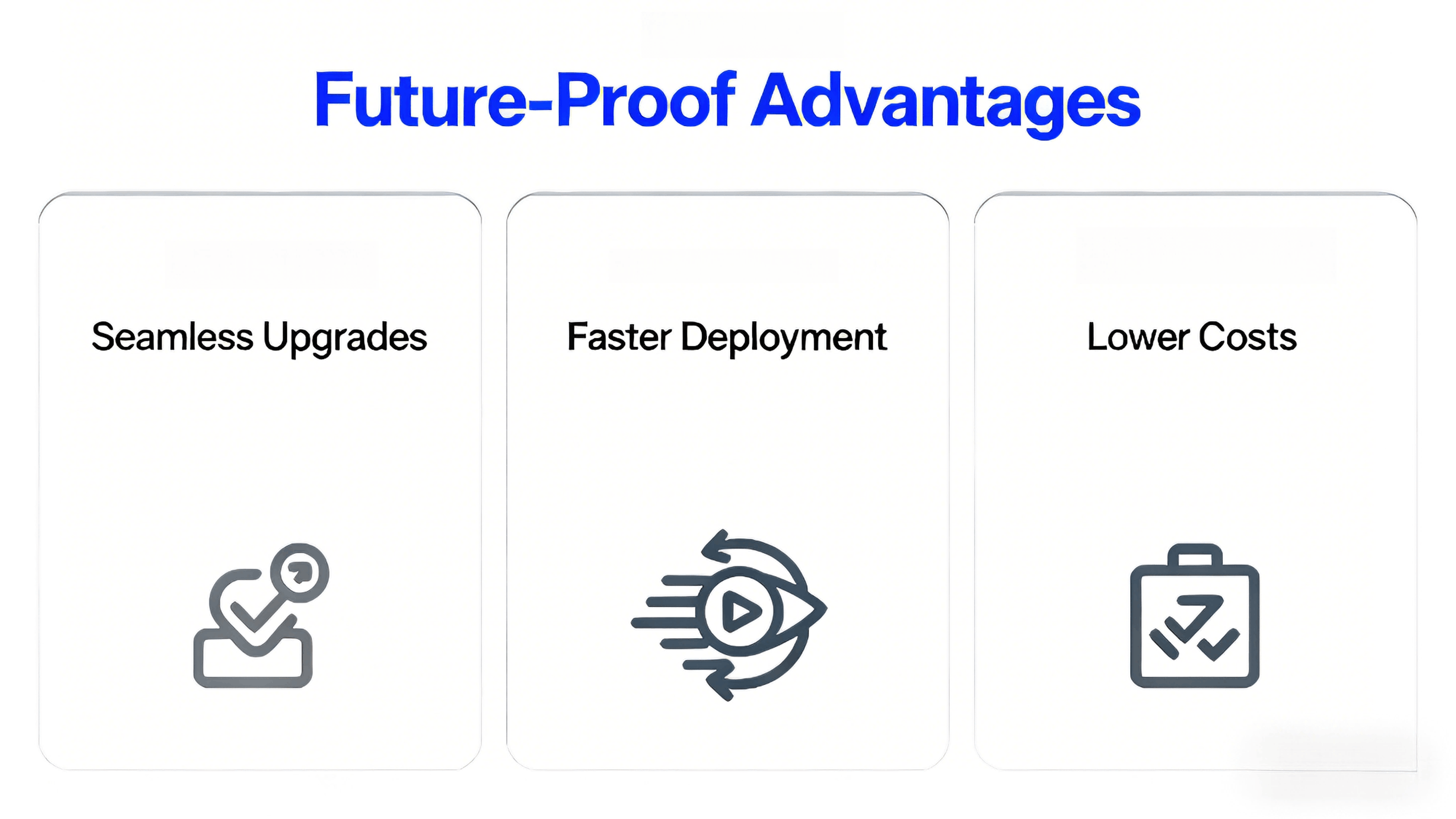
But a pre-validated configuration that evolves continuously gives organizations three major advantages:
1. Seamless Hardware Upgrades
When a new CPU, SSD, NIC, or firmware becomes available, it is validated in the lab before customers adopt it.
This ensures:
The latest technology can be deployed without unpredictability
No engineering time is lost re-running old tests
Systems stay modern without effort
2. Faster Deployment Cycles
Instead of:
“Test first, deploy later.”
Teams move to:
“Deploy immediately with confidence.”
Many organizations shorten deployment time from 6–10 weeks to a few days, accelerating:
Rack installation
New customer deployments
Fleet refresh cycles
Market response time
3. Lower Lifecycle Costs
Instead of discovering problems in the field—where outages are expensive—issues are caught in a dedicated lab environment.
This reduces:
RMAs
Emergency troubleshooting
SLA breaches
Lost engineering hours
Delayed rollouts
Over time, the savings compound as fleet size grows.
Continuous Integration Is the Key
A future-ready server ecosystem requires more than a one-time validation. It requires:
Ongoing testing
Continuous certification
Rapid updates to recommended configurations
A feedback loop between engineering, testing, and customers
This approach ensures that when:
A CPU receives microcode updates
A Linux kernel changes
ESXi modifies driver requirements
A new SSD controller hits the market
…your production environment is never caught off guard.
How Shenzhen Angxun Supports Customers
At Shenzhen Angxun Technology, all motherboard and system configurations undergo continuous validation inside our 10,000m² manufacturing and system integration facility. With 23 years of OEM/ODM manufacturing experience and advanced SMT and AOI/SPI test equipment, we maintain a living, continuously updated configuration checklist that ensures every system is proven stable before it reaches the customer.
This gives organizations:
Predictable deployment
Higher reliability
Faster time-to-production
Lower operational costs
Freedom from compatibility troubleshooting
The Result: IT Teams Spend Time Building, Not Debugging
In a market where technology refresh cycles are accelerating, the advantage goes to organizations that:
Stay current
Deploy confidently
Avoid wasting engineering talent on repetitive validation work
A pre-validated, continuously tested server configuration turns infrastructure into a competitive advantage, rather than a bottleneck.
Ready to Future-Proof Your Infrastructure?
If your team is still spending 150–250 hours validating every hardware and firmware combination, it may be time to consider a deployment model that is:
Proven
Tested
Stable
Ready on day one
Why spend months proving a configuration works
when that validation can be waiting for you?
Contact: Tom
Phone: 86 18933248858
E-mail: tom@angxunmb.com
Whatsapp:86 18933248858
Add: Floor 301 401 501, Building 3, Huaguan Industrial Park,No.63, Zhangqi Road, Guixiang Community, Guanlan Street,Longhua District,Shenzhen,Guangdong,China
We chat